



Chatbot 18 – The Tech Behind How do Chatbots Work

Chatbot 18 – The Tech Behind How do Chatbots Work
One of the most commonly asked questions on Quora for me is usually, “How do chatbots work?”
This article is the third in a four-part series called Chatbot 18. Other articles that were published in this series can be found here:
#1: Our Predictions for the Industry
#2: An Indepth Analysis into Chatbot Language
#4: Customer Engagement, Support and Marketing
However, unlike the other articles, in this post, we will be taking a closer look at how chatbots function and also deep dive into what to look for when investing in a chatbot solution.
In addition, if you would like an experiential product tour where we teach you how to build your own chatbot and take you through an in-depth walkthrough of the Verloop.io platform, then do schedule a demo with us to know more.
Now, back to our topic at hand….
What Is an AI Chatbot?
An AI chatbot is more than a scripted digital assistant, it’s a system designed to understand, learn from, and respond to human language in real time. Unlike traditional rule-based bots that follow pre-set decision trees, AI-powered chatbots use machine learning and natural language processing (NLP) to interpret user queries and respond with relevant, contextual answers.
Traditional Rule-Based Bots vs AI-Powered Chatbots
Rule-based bots operate like flowcharts. They’re built to recognise specific keywords and follow fixed conversational paths. If a customer types “Where is my order?”, the bot might only respond correctly if that exact phrase is programmed. Deviate slightly — “Has my package been shipped?” — and it might stumble or reply with a default message.
AI-powered chatbots, on the other hand, understand language patterns and intent, even when phrased differently. Using NLP, they break down sentences to grasp meaning, identify entities (like product names or dates), and respond with appropriate answers. They can also learn from interactions over time, getting better at recognising variations in phrasing, tone, and even slang.
Why AI Matters in Conversations
AI introduces context and dynamism. Let’s say a user chats about an invoice issue, switches topics to delivery, and then comes back to the invoice. A rule-based bot would likely get confused or restart the flow. An AI chatbot remembers context which is what’s already been discussed, and can seamlessly shift gears without making the customer repeat themselves.
This ability to think in threads rather than trees makes AI chatbots much more natural, human-like, and efficient in solving real-world customer problems. And that’s what turns a conversation into a conversation.
Now, enter Generative AI Agents. These agents don’t just recognise what you say; they generate thoughtful, natural responses in real-time. Whether it’s through a chatbot on your e-commerce site or a voice agent answering calls, Gen AI agents offer:
-
Conversational intelligence: They understand ambiguity, ask clarifying questions, and remember previous interactions.
-
Voice interaction: Paired with speech recognition and synthesis, Gen AI voice agents talk just like your support team — only faster and 24/7.
-
Seamless handoffs: They know when to involve a human agent and pass on full context to avoid repetition.
-
Continuous learning: They improve with every conversation, learning your brand tone and customers’ quirks.
In short, they’re not just rule-followers. They’re collaborators to help customers solve problems, make purchases, and feel heard.
| Feature | Rule-Based Chatbots | AI-Powered Chatbots (NLP-based) | Generative AI Agents (Chat & Voice) |
|---|---|---|---|
| Technology | Decision trees, keyword matching | Natural Language Processing (NLP), ML | LLMs (like GPT), speech models, APIs |
| Response style | Predefined, static | Contextual, adaptive | Natural, human-like, real-time generated |
| Context awareness | Limited (reset per session) | Moderate (remembers in-session) | High (can retain long conversations, threads) |
| Learning ability | None | Learns over time via training data | Self-improves using prompt tuning & feedback |
| Channel support | Usually text-only (web, basic messaging) | Multichannel (web, apps, WhatsApp) | Omnichannel – including voice (calls, IVR) |
| Personalisation | Low – generic answers | Moderate – basic profile-based | High – personalised using CRM & customer history |
| Setup effort | Manual flows, complex to scale | Requires training and maintenance | Faster to deploy, adaptable via prompts |
| Example use case | FAQ responder | Returns policy, order updates | Booking appointments, refund calls, escalations |
How do chatbots work?
Imagine for a minute what the process of communication with another human being is like.
Your mother asks you to go buy some Tropicana 100% Orange Juice.

Your first question is how much of it she wants.
- 1 litre?
- 500ml?
- 200?
She tells you she wants a 1-litre Tropicana 100% Orange Juice.
Now you know that regular Tropicana is easily available, but 100% is hard to come by, so you call up a few stores beforehand to see where it’s available. You find one store that’s pretty close by, so you go back to your mother and tell her you found what she wanted. It’s $2, maybe $3, and after asking her for the money, you go on your way.
What does Tropicana Orange have to do with anything? Well, this is the answer to the question that all your bosses and clients will eventually ask, “How do Chatbots work?”
A chatbot follows the same process, with two fundamental differences: the channel of communication and what you’re talking about. I’ll give you a step by step breakdown based on the most fundamental principles of AI/Chatbots.
In the mind of an AI Agent bot
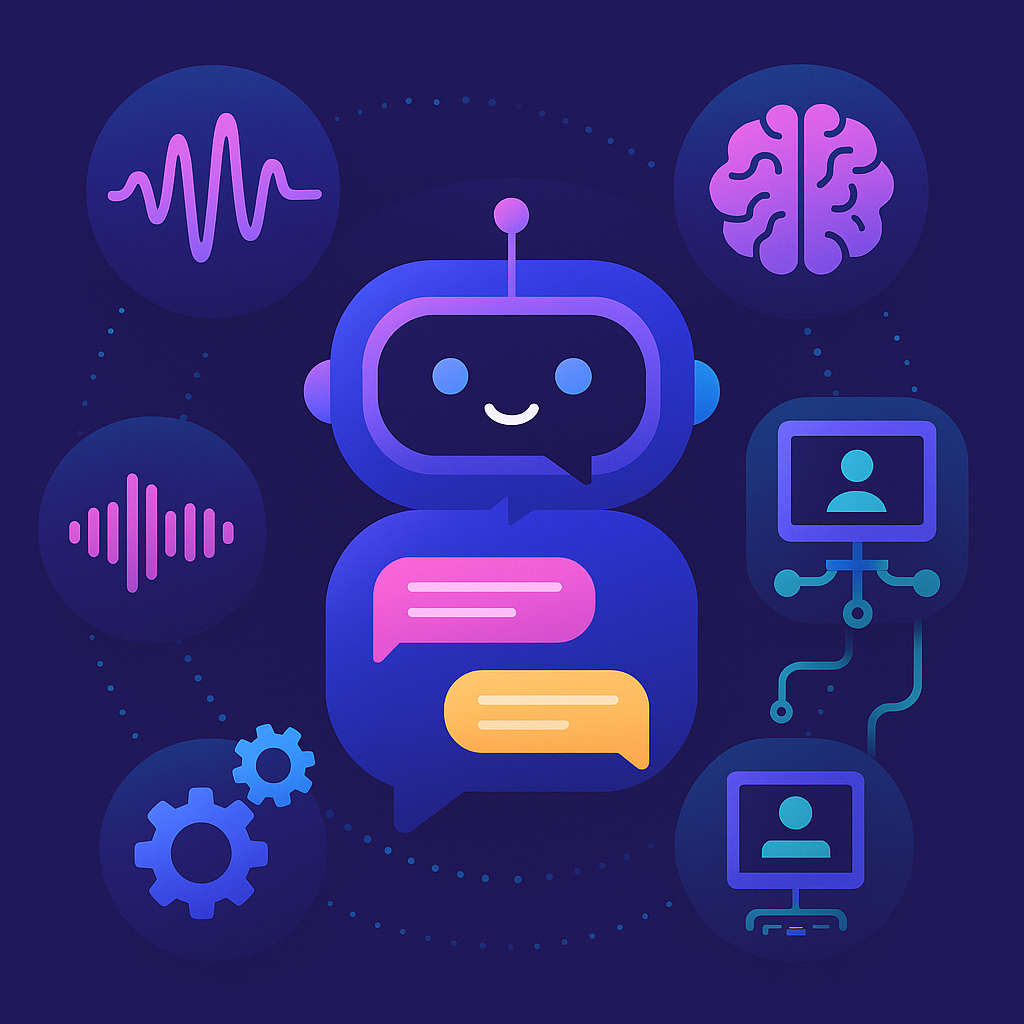
Let’s go back to the example of ordering a 1-litre bottle of Tropicana juice via a chatbot on Facebook Messenger. While it might seem like a simple back-and-forth, there’s a lot happening under the hood. Each message triggers a chain of AI technologies working together like a digital assembly line.
- Step 1:
You type: “Hey, I want some Tropicana.”
At this point, all the chatbot sees is unstructured text. This is where NLP steps in. Think of NLP as the bot’s way of listening and making sense of what you’re saying—even if you misspell a word or don’t follow perfect grammar.
-
Intent recognition: It figures out that your goal is to place an order.
-
Entity extraction: It identifies “Tropicana” as the product and logs that as a key detail.
-
- Step 2:
Now that the bot knows what you want, it needs more details. It sends your request to a decision engine, a logic layer that checks what’s still needed to complete the task.
In this case, it notices that you didn’t specify how much Tropicana you want. So, it decides to ask you.
-
Step 3: Here comes the reply: “How much Tropicana would you like?”
This sentence wasn’t pre-written. It was crafted using NLG—a system that takes structured logic (“need quantity info”) and turns it into a friendly question that sounds human.
- Step 4:
You respond with: “Just 1 litre.”
The chatbot parses this new input through NLP again (this time picking up the quantity = 1 litre), and it feeds the structured data back to the decision engine.Now, the bot has all the info it needs to move forward.
- Step 5:
The bot consults its knowledge base—a database of:
-
Available inventory (Tropicana SKUs)
-
Store locations
-
Stock levels
-
Distance to the user
It calculates the closest store that has stock and generates a price.
-
- Step 6:
At this point, Generative AI may come into play to:
-
Add a bit of personality to the reply (e.g. “Your Vitamin C boost is just a click away 🍊”)
-
Rephrase answers in your tone or language
-
Handle more open-ended queries (“What’s the healthiest juice?”)
-
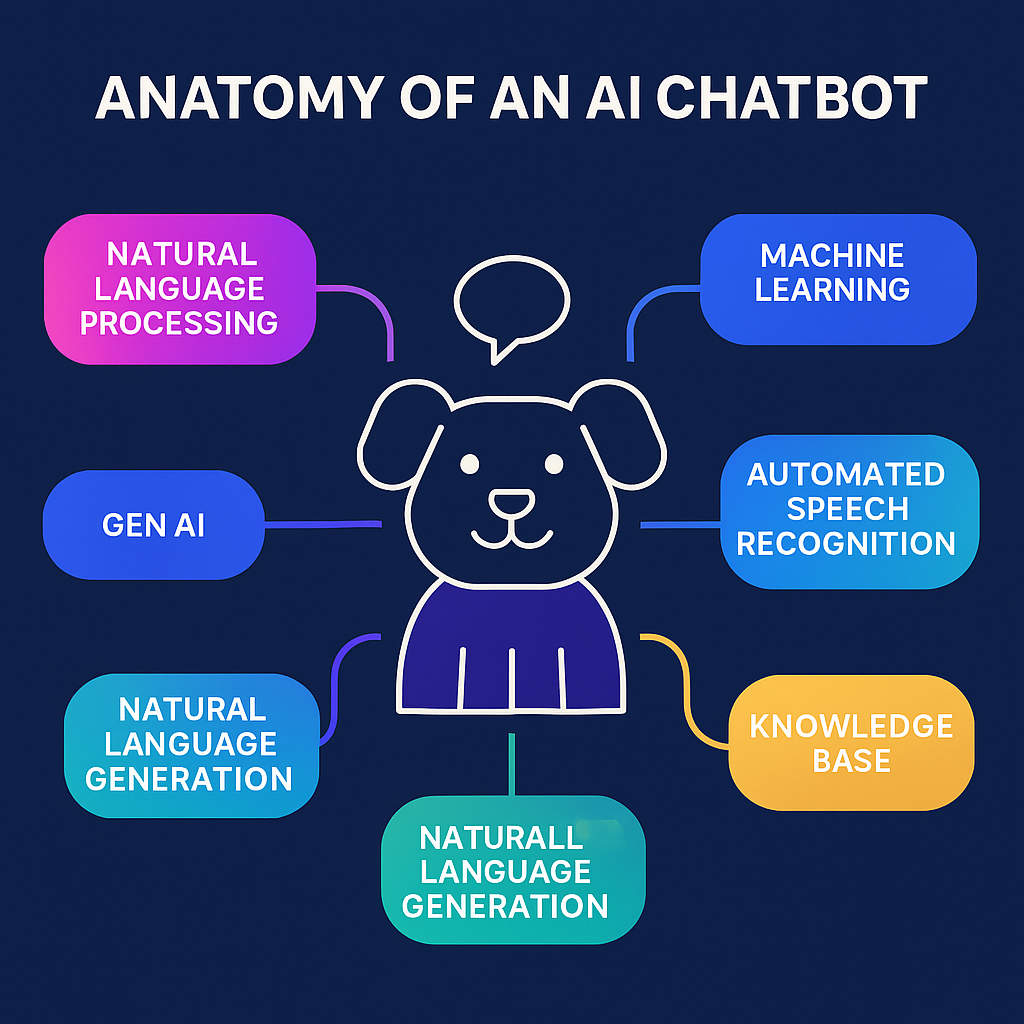
Core Technologies Behind AI Chatbots
AI chatbots are more than just scripted responders—they’re built on a stack of powerful technologies that enable them to understand, learn, and engage like a human. Let’s break down the core components that power modern AI and Gen AI chatbots:
Natural Language Processing (NLP)
NLP is the technology that enables machines to understand human language—not just literally, but contextually. It’s how your chatbot knows that “I can’t log in again” means there’s a login issue, not a casual statement.
Think of NLP like a smart translator, it listens to what your users say, figures out what they mean, and passes that meaning on to the AI agent.
-
Intent recognition: The bot identifies what the user wants to do (e.g. “I need a refund” = start refund process).
-
Entity extraction: Pulls out useful details like names, product IDs, or dates to act on (e.g. “my order from 2 June”).
-
Context retention: Remembers past interactions or earlier parts of the same conversation for better continuity.
Without NLP, a chatbot would just look for keywords and spit out pre-written answers. With NLP, bots can handle slang, typos, long-winded queries—even sarcasm. That’s what makes interactions feel natural instead of robotic.
Machine Learning (ML)
Machine Learning is how chatbots learn from experience. Instead of relying on fixed rules, they analyse previous interactions to spot patterns and improve responses with every new conversation.
ML is like a trainee who watches what works, what doesn’t, and adjusts behaviour accordingly. It helps in:
-
Pattern learning: Improves reply accuracy based on past chats and agent corrections.
-
Smart suggestions: Recommends better responses or next-best actions to human agents.
-
Behaviour tuning: Adapts tone, timing, and answer style based on user profiles or intent.
ML reduces the need for manual rule updates. Over time, it leads to faster, more relevant, and more human-like replies—especially in complex support situations where one-size-fits-all responses fall short.
Automated Speech Recognition (ASR)
ASR is the engine behind voice bots. It converts spoken words into written text that the AI can then process—accurately, and in real-time.
Imagine ASR as the ears of your voice AI, carefully transcribing what users say so the bot can respond meaningfully.
-
Real-time transcription: Converts live customer speech into actionable text.
-
Noise handling: Filters out background chatter or accents to maintain accuracy.
-
Speaker cues: Detects pauses and cues to maintain conversational flow.
Without ASR, voice AI wouldn’t understand the customer at all. It’s the first step in transforming a phone call into a smart, responsive dialogue—essential for banks, healthcare, or any phone-based service.
Natural Language Generation (NLG)
NLG is the technology that allows bots to write like humans. After understanding a request, the chatbot uses NLG to frame a natural, on-brand reply.
Think of it like a ghostwriter for your support team—one that adapts tone, context, and even humour if needed.
-
Human-like replies: Turns structured data into friendly messages.
-
Tone adaptation: Matches replies to your brand voice (formal, friendly, quirky, etc.).
-
Personalisation: Builds responses using specific user and product details.
Great replies build trust. With NLG, chatbots don’t just sound smart—they sound human. That makes a huge difference in retaining customers and resolving queries without friction.
Knowledge Base Integration
This is how your chatbot connects to FAQs, help docs, CRMs, or product databases. When a customer asks a question, the bot searches these sources to find the most relevant, accurate response.
It’s like giving your AI a search engine that only looks through your content.
-
Dynamic retrieval: Pulls answers based on the latest documentation or ticket data.
-
CRM lookups: Fetches user-specific info like order history, plan details, or support tier.
-
Fallbacks to agents: If no answer is found, routes the chat with full context to a live rep.
Even the smartest chatbot is only as good as the information it has. Knowledge base integration ensures that customers get up-to-date, accurate answers—automatically.
Generative AI (Gen AI)
Gen AI goes a step further than rule-based bots or even basic AI. It can generate fresh responses, summaries, explanations—or even rewrite messages—on the fly.
It’s like giving your chatbot a creative side: the ability to fill in the gaps, handle ambiguity, and express itself clearly.
-
Freeform replies: Handles open-ended queries with intelligent, brand-aligned responses.
-
Message rephrasing: Adjusts tone (friendly, professional, empathetic) based on context.
-
Conversation memory: Recaps and summarises past conversations when needed.
This is what powers the latest generation of voice and chat agents. Gen AI enables bots to handle nuanced, high-stakes interactions—such as payment issues or medical queries—without sounding scripted or stiff.
Suggested read: The Essential Chatbot Terminology for Beginners
Are they exactly like humans?
The biggest difference between chatbots and humans at this point of time though is what the industry calls empathy understanding. Chatbots simply aren’t as adept as humans at understanding conversational undertones.
For example, there’s a very large difference between the statements,
- “We need to talk baby!” and
- “We need to talk babe….”
While this is immediately apparent to a human being, it’s difficult for a machine to comprehend. Progress is being made in this field though and soon machines will not only be able to understand what you’re saying, but also how you’re saying it and what you’re feeling while you’re saying it.
Key Features That Make Chatbots Effective
What to look for when choosing your chatbot?
According to Accenture Digital, 57% of businesses claim that a conversational chatbot delivers a large ROI on minimal investment. This makes deploying a chatbot extremely attractive, but in order for you to find and invest in the right chatbot, here are a few features that we feel you should look for.
1. Real-time monitoring.
Real-time data delivery can help you take strategic decisions proactively and oversee customer conversations happening at the moment.
2. Omnichannel support.
Being on platforms that your customers are already on and are comfortable with is crucial if you want to offer extremely easy, robust and personalised customer experiences
3. Continuous AI training.
Having a customer support chatbot provider that will let you continuously train and build your chatbot with FAQs training data, along with the ability to add more intents and entities in turn optimising your chatbot to cover more use cases is a crucial feature you cannot overlook.
4. Extensive integrations.
Make sure that the chatbot you choose for your website is able to offer seamless integration with other products and services that your business uses.
5. Analytical data.
Ensure that your chatbot platform offers you an AI-driven analytical dashboard, this will allow you to turn raw data into actionable insights in simple visual formats for easy consumption.
While these are a few key features to keep in mind while investing in your chatbot, it is extremely hard to prescribe a one-size-fits-all solution. Finding the right chatbot requires finesse and patience and a clear understanding of your business’ needs and priorities.
In case, you have more queries and are overwhelmed with the information regarding the best features to look out for and what the biggest red flags to avoid are, we’ve got you covered.
Join us on our upcoming Demo Day to learn more about how to build your chatbot and what to look for when choosing one. It’s a fun, extremely visual and brief event. And we think it will be of great value and insight as you level up your customer support game.
Challenges and Limitations of AI Chatbots
For all their speed and efficiency, AI chatbots aren’t flawless. Behind the polished responses lie a few areas where things can go sideways—and it’s important to know what those are before you fully depend on one.
1. Misunderstanding Complex Queries
AI chatbots excel at structured, predictable conversations. But throw in a slightly tangled query—like “Can I change the address on the order I placed last Friday but want delivered to my office instead of home?”—and things may break.
Multiple intents in one sentence can confuse the bot, especially if the logic hasn’t been trained to handle overlapping goals.
2. Missing the Subtext
Bots aren’t known for their sense of humour—and sarcasm is often completely lost on them. If a customer types “Oh great, my order’s late again. Just perfect,” the chatbot might actually thank them for the compliment. 😬
Without emotional intelligence, such misfires can come off as robotic—or worse, insensitive.
3. Gen AI Hallucinations
Generative AI has made chatbots more capable—but also riskier. A common issue is hallucination: where the AI confidently gives a response that’s factually incorrect, or completely fabricated.
Without proper guardrails, this can lead to misinformation being shared with customers—damaging trust.
4. Data Privacy and Bias
Training data isn’t always neutral. If biased data slips into the system, it can reflect in how the chatbot responds—favouring certain accents, languages, or tones.
And when bots handle sensitive information (e.g., banking details or medical records), data privacy and compliance become critical. Without proper encryption and access control, the risk of breaches increases.